
CCPBioSim brings together chemists, physicists, biologists and engineers who share the conviction that the best science arises when theory and experiment are tightly integrated. Our consortium develops and applies computational simulation methods spanning an enormous range of length and time scales, from quantum electrons to whole chromosomes, to understand biological molecules, inform drug design and guide the engineering of functional biomaterials.
Ladder of Scales
Methods used by CCPBioSim span from sub-ångström quantum detail to micrometre cellular organisation
Each panel below describes one major methodological domain. Key references are drawn from CCPBioSim management group members.
Hybrid QM/MM Simulation
Active-site · ps-nsWhen a biological process involves chemical bond formation or breaking, such as enzyme catalysis, light absorption or radical reactions, and classical force fields are insufficient. Hybrid Quantum Mechanics / Molecular Mechanics (QM/MM) methods treat the chemically active region (typically 50-300 atoms) with an accurate quantum-mechanical Hamiltonian (DFT, MP2 or semi-empirical methods), while the surrounding protein and solvent are handled by an MM force field.
This combination gives near-chemical-accuracy free-energy barriers for enzyme reactions whilst remaining computationally tractable. ChemShell, a code from the Materials Chemistry Consortium (MCC) and endorsed by CCPBioSim, provides a flexible Python-based QM/MM framework coupling leading QM engines (ORCA, NWChem, Turbomole) to MM packages such as CHARMM and AMBER.
- Jabeen, Beer, Spencer, van der Kamp, Bunzel & Mulholland: Electric fields are a key determinant of carbapenemase activity in class A β-lactamases: QM/MM MD dissecting antibiotic resistance. ACS Catalysis 14, 7697-7710 (2024); DOI 10.1021/acscatal.3c05302
- Chudyk, Beer, Limb, Jones, Spencer, van der Kamp & Mulholland: QM/MM simulations reveal determinants of carbapenemase activity in class A β-lactamases. ACS Infect. Dis. 8, 2008-2017 (2022); DOI 10.1021/acsinfecdis.2c00152
- Rosta, Yang & Hummer: QM/MM simulations of RNA backbone cleavage by ribonuclease H, establishing the two-metal-ion catalytic mechanism.J. Am. Chem. Soc. 133, 8934-8941 (2011); DOI 10.1021/ja200173a
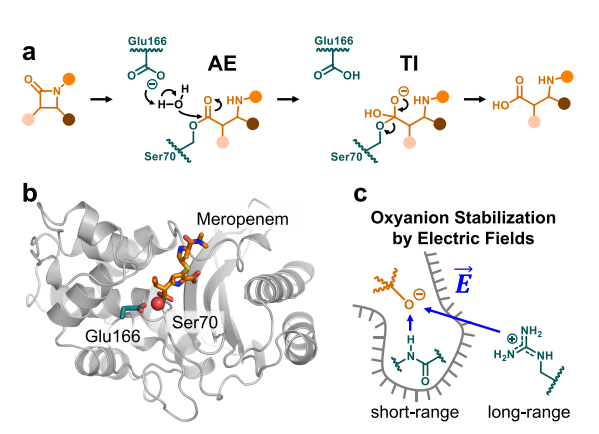
Figure taken from Jabeen et. al.
Atomistic Molecular Dynamics
1-100 nm · ns-µsMolecular Dynamics (MD) simulates the time-evolution of biological systems by numerically integrating Newton's equations of motion for every atom. Forces are evaluated from empirical force fields such as CHARMM, AMBER or GROMOS to name a small few, which encode bonded and non-bonded interactions including electrostatics and van der Waals terms.
Starting from a crystal or cryo-EM structure, researchers can follow protein conformational changes, membrane dynamics, nucleic-acid flexibility and drug binding: phenomena inaccessible to static structural methods. Modern GPU-accelerated codes such as AMBER, GROMACS, NAMD and OpenMM routinely access microsecond timescales on standard HPC clusters.
CCPBioSim's BioSimDB database curates trajectories contributed by the community, lowering barriers for new users and enabling meta-analyses across diverse biomolecular systems.
- Khalid et al.: Computational microbiology of bacteria: advances in MD simulations of full cell envelopes including crowded periplasm models. Structure 31, 1320-1327 (2023); DOI 10.1016/j.str.2023.09.012
- Haldar, Zhang, Xia, Islam, Liu, Gervasio, Mulholland, Waller, Wei & Haider: Mechanistic insights into ligand-induced unfolding of an RNA G-quadruplex via well-tempered metadynamics. J. Am. Chem. Soc. 144, 935-950 (2022); DOI 10.1021/jacs.1c11248
- Im & Khalid: Molecular simulations of gram-negative bacterial membranes come of age (review). Annu. Rev. Phys. Chem. 71, 171-188 (2020); DOI 10.1146/annurev-physchem-103019-033434
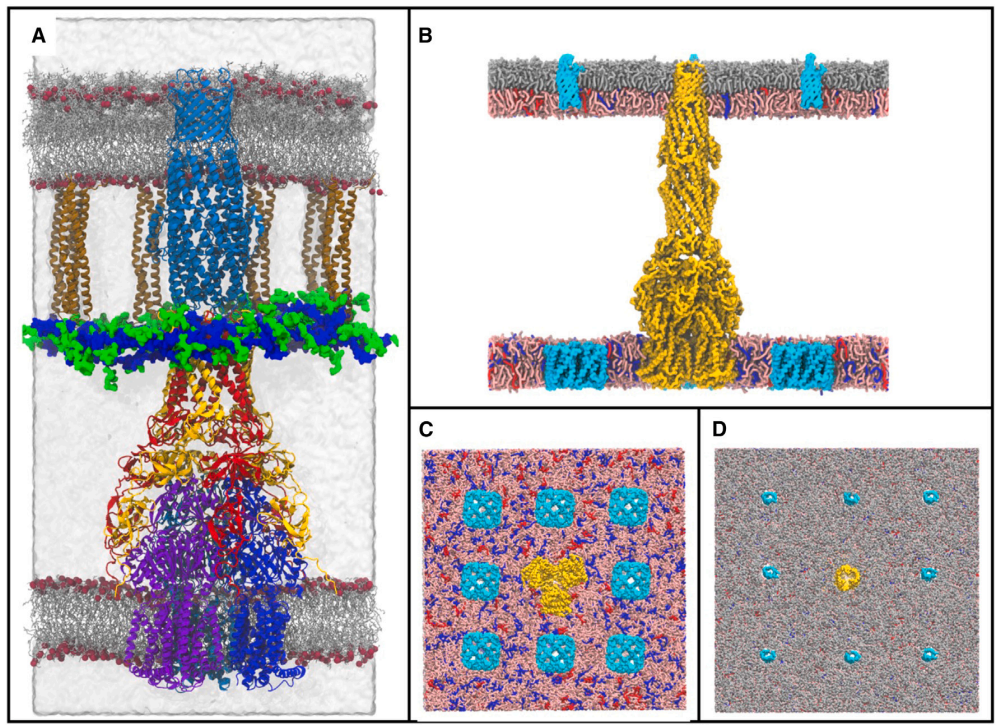
Figure taken from Khalid et. al.
Enhanced Sampling & Free Energy Calculations
nm-µm · µs-ms effectiveMany biologically important processes, such as rare conformational transitions, ligand binding and unbinding and protein folding, occur on timescales far beyond what unbiased MD can reach. Enhanced sampling methods artificially accelerate exploration of the free energy landscape whilst preserving statistical rigour.
Key techniques championed within CCPBioSim include alchemical free energy perturbation (FEP) and thermodynamic integration for computing protein-ligand binding affinities, metadynamics and umbrella sampling for mapping conformational free energy surfaces, and replica exchange methods for overcoming kinetic traps. These are increasingly automated and deployed in drug discovery pipelines.
- Clark, Robb, Cole & Michel: Automated adaptive absolute binding free energy calculations, enabling large-scale ligand screening. J. Chem. Theory Comput. 20, 7806-7828 (2024); DOI 10.1021/acs.jctc.4c00806
- Scheen, Wu, Mey, Tosco, Mackey & Michel: Hybrid alchemical free energy / machine-learning methodology for hydration free energies. J. Chem. Inf. Model. 60, 5331-5339 (2020); DOI 10.1021/acs.jcim.0c00600
- Mey, Allen, Bruce Macdonald et al.: Best practices for alchemical free energy calculations: community guidelines. LiveCoMS 2, 18378 (2020); DOI 10.33011/livecoms.2.1.18378
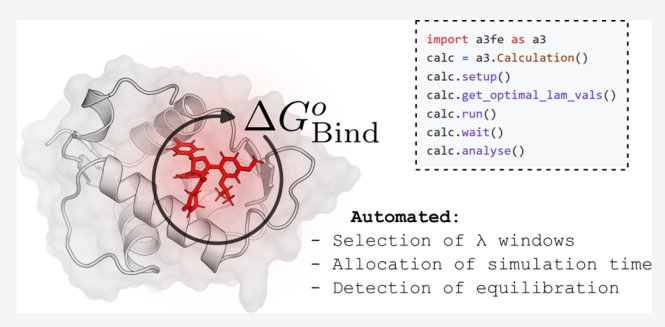
Figure taken from Clark et. al.
Coarse-Grain & Mesoscale Modelling
10-500 nm · µs-msMany biologically compelling phenomena, including membrane remodelling, viral capsid assembly, chromatin compaction and phase separation of membraneless organelles, involve length scales from tens of nanometres to micrometres that are computationally prohibitive with atomistic detail.
Coarse-grain (CG) models replace groups of atoms with single interaction sites (beads), dramatically reducing the degrees of freedom. The Martini force field, widely used within the consortium, maps roughly four heavy atoms to one bead and reproduces membrane structure, lipid diffusion and protein-lipid interactions with quantitative accuracy. For even larger scales, Brownian Dynamics, Lattice-Boltzmann and continuum elastic approaches replace Newtonian mechanics entirely.
Prof. Collepardo (Cambridge) has developed multiscale chromatin models that combine CG representations with enhanced sampling to study nucleosome organisation and liquid-liquid phase separation in the nucleus.
- Zhou, Huertas, Maristany … Collepardo-Guevara, Rosen et al.: Multiscale structure of chromatin condensates explains phase separation and viscoelastic material properties. Science adv6588 (2025); DOI 10.1126/science.adv6588
- Farr, Woods, Joseph, Garaizar & Collepardo: Nucleosome plasticity is a critical element of chromatin liquid-liquid phase separation. Nat. Commun. 12, 2883 (2021); DOI 10.1038/s41467-021-23090-3
- Joseph, Reinhardt et al. & Collepardo: Physics-driven coarse-grained model for biomolecular phase separation with near-quantitative accuracy. Nat. Comput. Sci. 1, 732-743 (2021); DOI 10.1038/s43588-021-00155-3
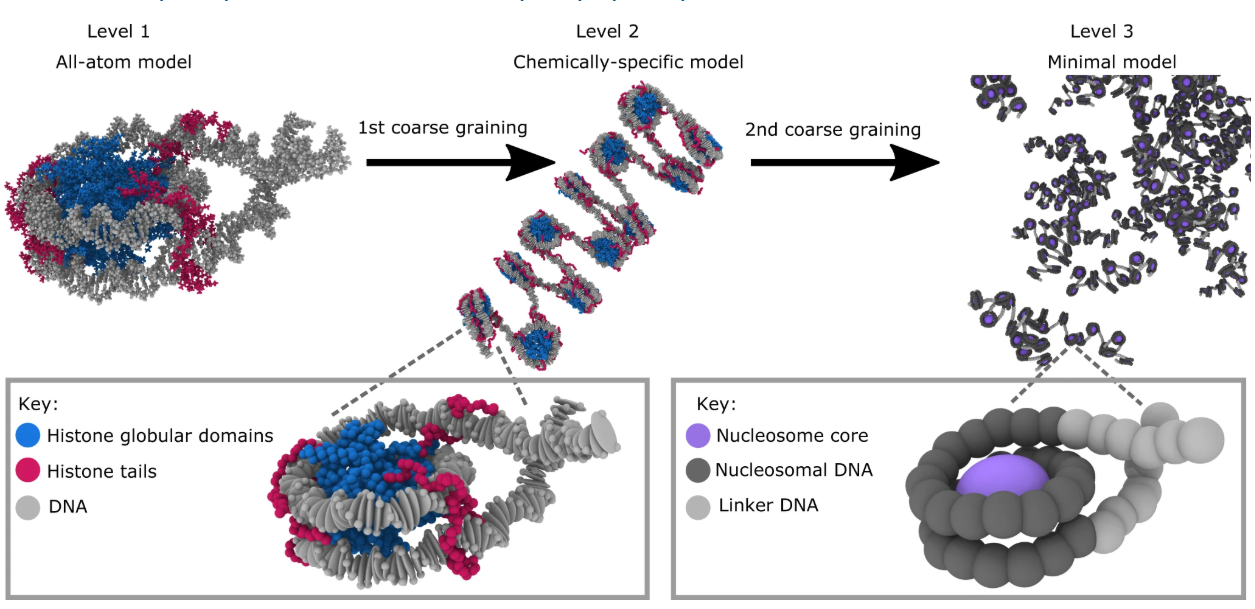
Figure taken from Farr et. al
Multiscale & Integrated Modelling
All scales · experiment-guidedReal biological problems rarely respect a single scale. Multiscale modelling formally couples two or more levels of theory, for example QM/MM linked to a CG region, to describe complex events such as enzyme-driven membrane remodelling or signal transduction across a cell.
CCPBioSim actively promotes integrated experimental-computational workflows that combine MD with neutron/X-ray scattering (SAXS, SANS), cryo-EM, NMR and single-molecule FRET. Collaborative projects with CCP-EM, CCP4 and CCPN under the DRIIMB initiative create seamless pipelines from raw experimental data to refined molecular models.
CCPBioSim's annual conferences, including the joint CCPBioSim/CCP5 Multiscale Modelling meetings, provide the community forum where these integrated approaches are developed and critically evaluated.
- Negro, Semeraro, Cook & Marenduzzo: A unified-field theory of genome organization and gene regulation, using 3D polymer simulations to predict transcriptional activity genome-wide across cell types. iScience 27, 111218 (2024); DOI 10.1016/j.isci.2024.111218
- Brackley, Taylor, Papantonis, Cook & Marenduzzo: Nonspecific bridging-induced attraction drives clustering of DNA-binding proteins and genome organisation. Proc. Natl. Acad. Sci. USA 110, E3605-E3611 (2013); DOI 10.1073/pnas.1302950110
- Khalid, Schroeder, Bond & Duncan: What have molecular simulations contributed to understanding of gram-negative bacterial cell envelopes? Microbiology 168, 001165 (2022); DOI 10.1099/mic.0.001165
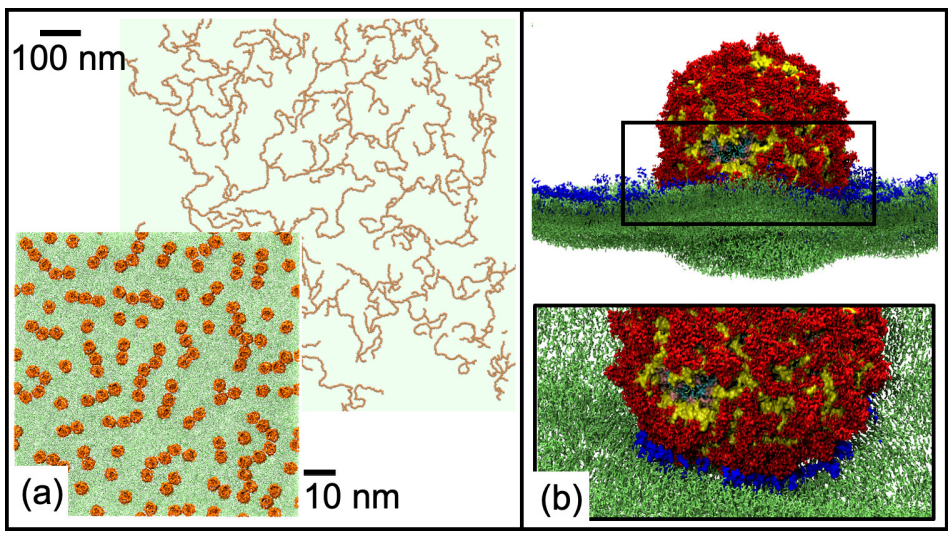
Figure taken from Khalid et. al.
Machine Learning & Data-Driven Methods
All scales: accelerating simulationArtificial intelligence and machine learning are reshaping every tier of biomolecular simulation. Machine-learned potentials (MLPs), trained on DFT reference data, approach QM accuracy at a fraction of the computational cost, enabling reactive MD on large systems. Neural network force fields (e.g. ANI, SchNet, MACE) are beginning to replace empirical force fields for drug-like molecules.
At the structural biology level, AlphaFold has revolutionised protein structure prediction, providing starting models for simulation that were previously unavailable. CCPBioSim members are at the forefront of combining AlphaFold predictions with MD to assess structure reliability, generate conformational ensembles and guide drug design.
Active-learning loops combining free energy calculations with Bayesian optimisation or reinforcement learning now accelerate hit-to-lead optimisation in pharmaceutical pipelines. ML is also transforming trajectory analysis: dimensionality reduction, Markov state models and deep-learning classifiers extract mechanistic insight from the vast datasets generated by modern HPC simulations.
- Runcie & Mey: SILVR: guided diffusion for target-aware molecule generation, conditioning an equivariant diffusion model without retraining using SARS-CoV-2 protease fragment hits. J. Chem. Inf. Model. 63, 5996-6005 (2023); DOI 10.1021/acs.jcim.3c00667
- Scheen, Mackey & Michel: Data-driven generation of perturbation networks for relative binding free energy calculations using a deep learning model trained on solvation free energy transformations. Digital Discovery 1, 870-885 (2022); DOI 10.1039/D2DD00083K
- Gorantla, Kubincová, Suutari, Cossins & Mey: Benchmarking active learning protocols for ligand-binding affinity prediction, evaluating Gaussian process and graph neural network models to establish best practices for AI-guided compound prioritisation. J. Chem. Inf. Model. 64, 1955-1965 (2024); DOI 10.1021/acs.jcim.4c00220
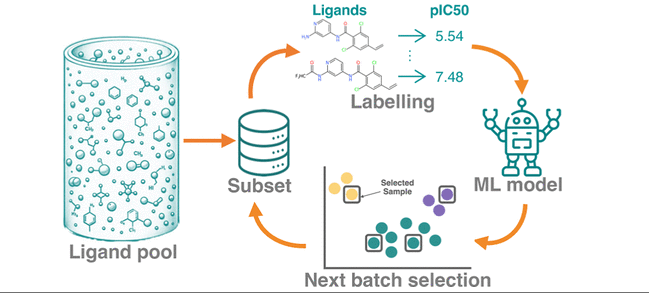
Figure taken from Gorantla et. al.
These methods are not used in isolation. CCPBioSim's unique contribution is to develop, validate and integrate them, lowering the barrier for non-experts and pushing the scientific frontier for specialists, through training, software and community.
Explore our software portfolio, upcoming events and training workshops to find out more.